


Have you ever pressed your garage remote and wondered whether your opener is actually the right one for your home?
A garage door opener is something most homeowners use every day, yet it is often overlooked until it becomes noisy, unreliable, or stops working. The right system can make a noticeable difference in security, convenience, noise level, and daily comfort.
The market has also changed. Modern garage door openers can include Wi-Fi control, battery backup, LED lighting, motion detection, smartphone alerts, and improved safety systems.
However, more features do not automatically mean a better choice. The best garage door opener for a small attached garage may be very different from the right option for a large, heavy door.
In this guide, we will explain the main opener types, important safety features, drive systems, smart-home functions, and installation considerations. You will also learn what to look for before spending money on a new garage door opener.
What Makes the Best Garage Door Openers Worth Buying?
The best garage door openers are not simply the most powerful or expensive models.
Instead, a good opener should match the weight and size of your garage door, your noise preferences, available ceiling space, security needs, and how often you use the garage.
For example, a homeowner with a bedroom directly above the garage may care much more about quiet operation than someone with a detached garage.
Similarly, someone who regularly leaves home without remembering whether the garage door is closed may benefit greatly from a smart opener with smartphone notifications.
When comparing models, consider these factors:
- Drive type
- Motor power
- Door weight
- Noise level
- Safety sensors
- Battery backup
- Wi-Fi connectivity
- Smartphone compatibility
- Lighting
- Installation requirements
- Warranty and replacement parts
Moreover, the opener should be compatible with the garage door itself. A powerful motor cannot compensate for a damaged, poorly balanced, or incorrectly installed door.
Best Garage Door Openers: Understanding Drive Types
One of the first decisions is the type of drive mechanism.
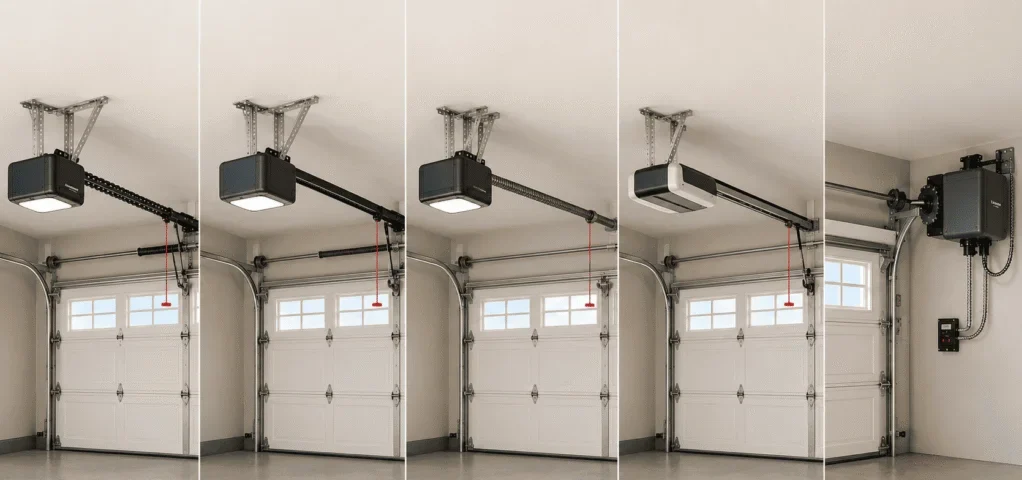
Most residential openers use one of three common systems: chain drive, belt drive, or screw drive. Wall-mounted jackshaft systems are another option for certain garages.
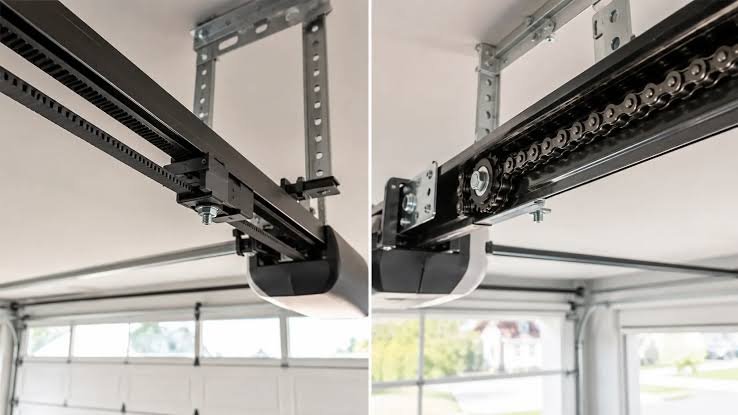
Chain-Drive Garage Door Openers
Chain-drive openers use a metal chain to move the trolley along the rail.
They are popular because they can provide strong performance and are often available at competitive prices.
A chain-drive system can be a practical choice for:
- Heavier garage doors
- Detached garages
- Homeowners who prioritize value
- Frequent daily use
The main drawback is noise. The metal chain can produce more vibration and mechanical sound than a belt-drive system.
Belt-Drive Garage Door Openers
Belt-drive models use a reinforced belt rather than a metal chain.
They are generally known for smoother and quieter operation, making them attractive for attached garages and homes with living areas near the garage.
If your garage is below a bedroom or home office, reducing vibration can be especially useful.
Screw-Drive Openers
Screw-drive systems use a threaded steel rod to move the trolley.
They have fewer moving parts than some traditional systems and can provide reliable operation. However, their suitability depends on the specific garage door and climate.
Temperature and maintenance requirements should be checked before choosing this design.
Belt vs Chain: Which Should You Choose?
The belt vs chain garage door opener question does not have one universal answer.
A chain drive may make sense when strength and value are priorities. A belt drive may be preferable when quiet operation is more important.
In short, choose according to your garage rather than simply choosing the most popular drive type.
Motor Power Matters More Than You May Think
Garage door openers commonly come in different motor strengths.
You may see ratings such as 1/2 HP, 3/4 HP, or 1 1/4 HP equivalent ratings depending on the manufacturer and motor design.
However, homeowners should not assume that the biggest motor is automatically the best choice.
The garage door’s weight, balance, construction, and track system all affect how much effort is needed.
For example, a lightweight single-car garage door may not need the same motor capacity as a large insulated double garage door.
If you have a particularly heavy wooden or custom garage door, look for a heavy duty garage door opener designed for the appropriate door weight and usage.
Most importantly, have a professional inspect a heavy or poorly balanced door rather than trying to compensate for mechanical problems with a stronger opener.
Garage Door Opener Safety Should Come First
Convenience is important, but safety should be the first consideration.
In the United States, automatic residential garage door operators are covered by a mandatory federal safety standard. The U.S. Consumer Product Safety Commission states that automatic residential garage door operators must comply with 16 CFR Part 1211.
Modern systems are designed with entrapment protection features.
These can include photoelectric safety sensors and automatic reversing mechanisms. The purpose is to help prevent the door from continuing to close when an obstruction is detected.
Test the Safety Reverse System
CPSC recommends testing the reversing function regularly according to the manufacturer’s instructions. Its safety guidance also emphasizes that older non-reversing openers should be repaired or replaced.
A simple maintenance routine can include:
- Check that the photoelectric sensors are aligned.
- Make sure nothing blocks the sensor path.
- Test the automatic reverse system according to the owner’s manual.
- Watch the door while it operates.
- Arrange professional service if the door behaves unexpectedly.
Never stand underneath a moving garage door to test it.
Additionally, keep children and pets away from the door’s path while it is moving.
Smart Garage Door Openers Add a New Level of Convenience
Smart technology has become one of the most useful developments in residential garage door systems.
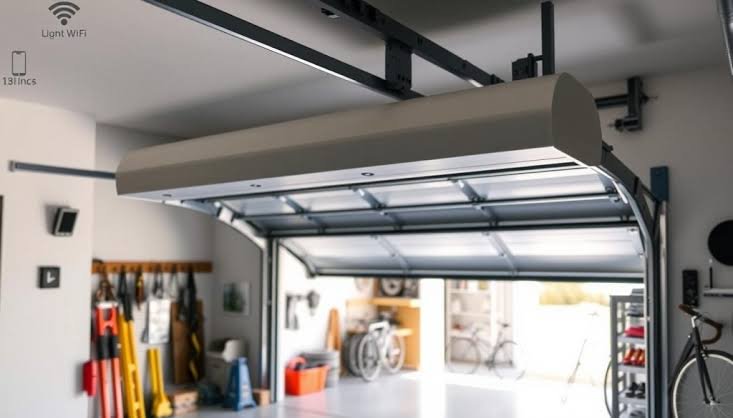
A Wi-Fi-enabled opener can allow you to control or monitor the garage door through a smartphone app, depending on the model.
Some systems can also send alerts when the door opens or closes.
This can be particularly useful if:
- You frequently forget to close the garage door.
- Family members need access while you are away.
- You want remote monitoring.
- You use a smart-home system.
- You want activity notifications.
For example, imagine leaving home in a hurry and later wondering whether you closed the garage door. With a compatible smart system, you may be able to check its status from your phone.
However, smart features should complement—not replace—basic physical security.
Use strong account passwords, enable available security protections, and keep the opener’s firmware updated when the manufacturer provides updates.
Battery Backup Can Be a Valuable Feature
A garage door opener is most useful when you actually need it.
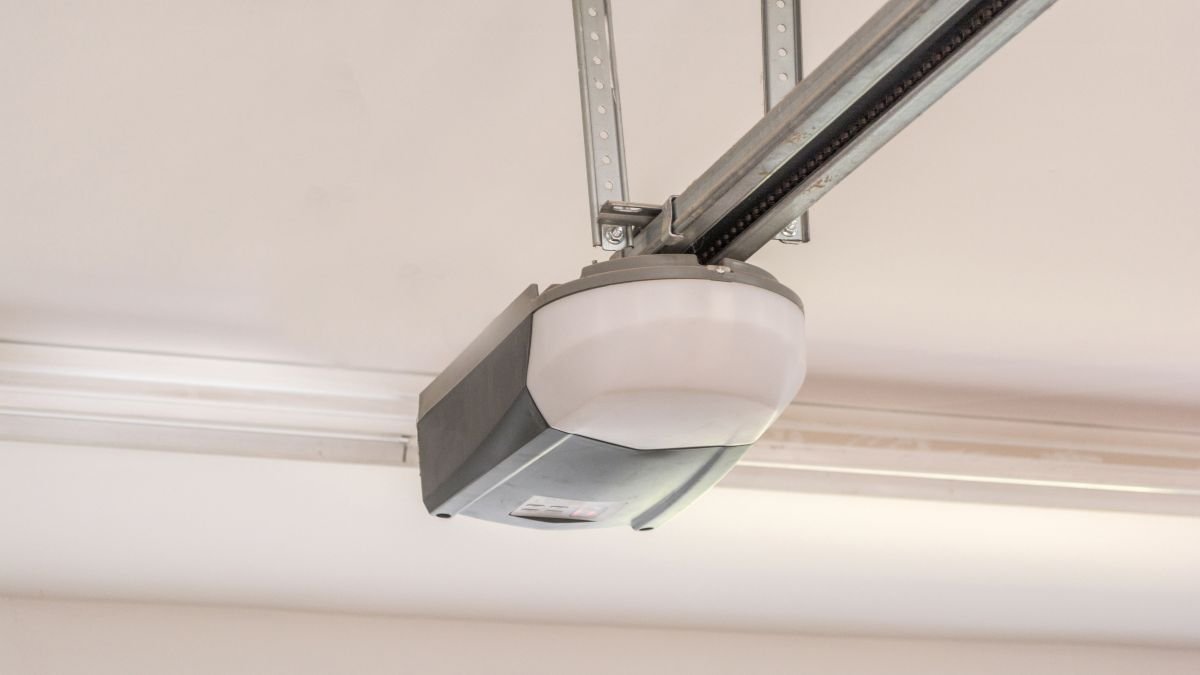
Unfortunately, power outages can make an electrically powered opener unavailable unless it includes a battery backup system.
A backup battery can allow the opener to operate during certain power interruptions, although the exact number of cycles depends on the model and conditions.
This can be especially helpful when the garage is the main entrance to the home.
Before buying, check:
- Battery capacity
- Number of expected cycles
- Recharge time
- Replacement cost
- Whether the battery is included
In addition, remember that the manual emergency release should remain accessible and functional.
What Is the Quietest Garage Door Opener?
If noise is your main concern, start by looking at belt-drive systems.
The quietest garage door opener for your home will depend on more than the motor itself. Installation quality, door balance, rollers, hinges, tracks, and vibration can all affect the sound you hear.
For example, replacing an old opener with a quiet belt-drive model may still leave you disappointed if the garage door’s metal rollers are worn or the tracks are poorly maintained.
Therefore, consider the entire door system.
A professional inspection can identify vibration or mechanical noise that an opener replacement alone may not solve.
Wall-Mounted vs Ceiling-Mounted Garage Door Openers
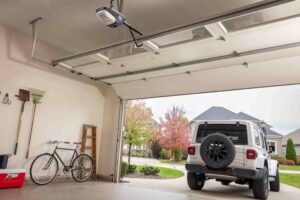
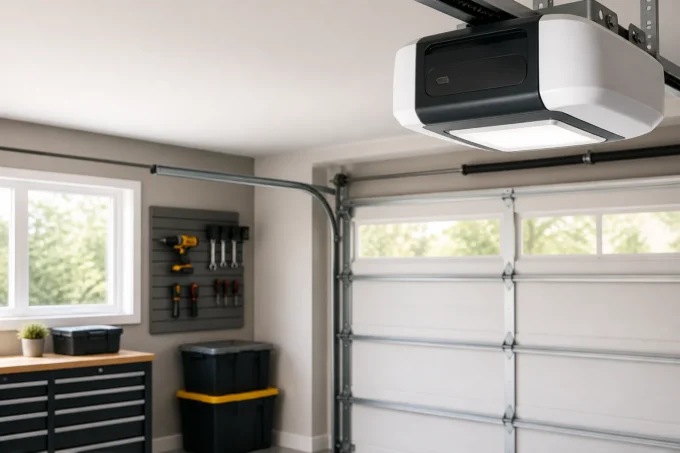
Traditional garage door openers are installed on the ceiling and use a rail extending toward the door.
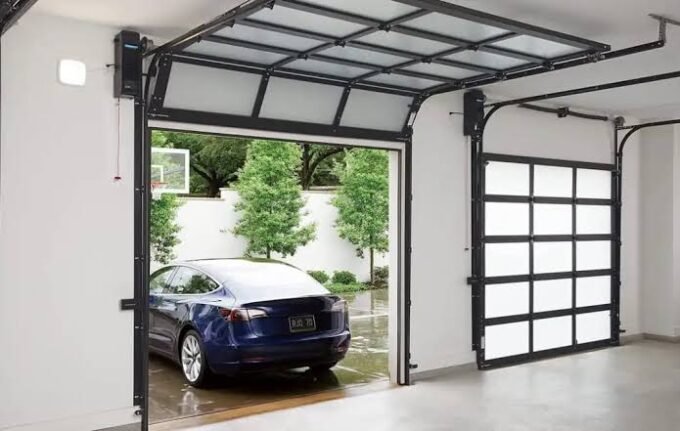
A wall-mounted jackshaft opener works differently. It is installed beside the garage door and operates the torsion bar.
The wall mount garage door opener vs ceiling mount decision depends heavily on the garage layout.
Wall-Mount Advantages
A wall-mounted opener can:
- Free up ceiling space
- Reduce overhead equipment
- Work well with certain high or unusual ceilings
- Provide a cleaner appearance
- Be useful when overhead storage is important
Ceiling-Mount Advantages
Traditional ceiling-mounted models are widely available and often offer:
- More choices
- Competitive pricing
- Straightforward replacement options
- Compatibility with many standard garage configurations
However, not every garage is suitable for every wall-mounted system.
Always check the manufacturer’s installation requirements before purchasing.
Features to Look for in the Best Garage Door Openers
Instead of focusing only on horsepower, create a checklist.
1. Safety Sensors
Photoelectric sensors are an important safety feature. Keep them clean and correctly aligned.
2. Automatic Reversal
The opener should have an appropriate reversing system and be maintained according to manufacturer instructions.
3. Battery Backup
This can provide access during a power outage.
4. Wi-Fi Connectivity
Smart connectivity can allow remote monitoring and control.
5. LED Lighting
Integrated LED lights can improve visibility inside the garage.
6. Rolling-Code Security
Some modern remotes use changing codes to make unauthorized code duplication more difficult.
7. Manual Release
Make sure the emergency release mechanism is accessible and understood by household members.
8. Soft Start and Stop
Some models gradually start and stop the door, helping create smoother operation.
Top Rated Garage Door Openers: What Should You Compare?
When shoppers look at top rated garage door openers, it is tempting to compare star ratings alone.
However, ratings do not tell the entire story.
A better approach is to compare the features that matter to your specific garage.
| Feature | Why It Matters |
| Belt drive | Lower noise and vibration |
| Chain drive | Strong performance and value |
| Wall mount | Saves ceiling space |
| Wi-Fi | Remote monitoring and control |
| Battery backup | Operation during outages |
| LED lighting | Better garage visibility |
| Smart alerts | Helps monitor door activity |
| Strong motor | Useful for compatible heavier doors |
For example, a highly rated opener designed for a standard garage may not be the right choice for an unusually heavy custom door.
The goal is compatibility, not simply popularity.
Installation: DIY or Professional?
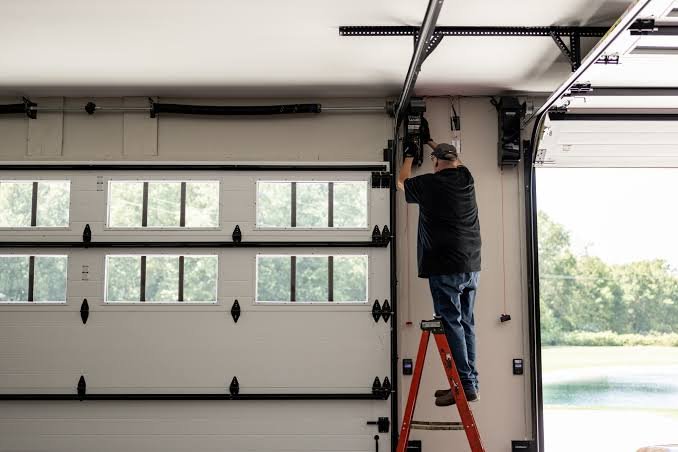
Some homeowners are comfortable installing garage door openers themselves.
However, garage doors contain heavy components and high-tension springs. Mistakes involving springs, cables, or other hardware can create serious hazards.
UL Solutions notes that the safety of these systems depends not only on selecting the proper certified product but also on correct installation, use, and maintenance.
Therefore, professional installation may be a sensible choice when:
- The door is unusually heavy.
- The springs need adjustment.
- The tracks are damaged.
- The garage has an unusual layout.
- You are replacing a wall-mounted system.
- You are unsure about electrical requirements.
A new opener cannot fix a garage door that is mechanically unsafe.
Personal Insight: Don’t Ignore the Garage Door Itself
One of the most common mistakes homeowners make is focusing entirely on the opener.
From a practical standpoint, the opener and the garage door work as one system.
If the door is properly balanced, the opener generally has an easier job. If the door is binding, excessively heavy, or damaged, installing a stronger motor may simply hide the underlying problem.
For example, imagine replacing an old 1/2-HP opener with a much stronger model because the door feels difficult to lift.
If the real issue is a damaged spring or poor balance, the new opener is not necessarily solving the problem.
That is why an experienced installer should inspect the entire system before recommending a replacement.
Maintenance Tips for Long-Term Performance
Even the best garage door opener needs regular attention.
A few minutes of inspection can help identify problems before they become expensive repairs.
Monthly Checks
Consider checking:
- Safety sensor alignment
- Door movement
- Unusual sounds
- Remote operation
- Wall control
- Emergency release
- Automatic reversal
- Mounting hardware
CPSC specifically recommends regular testing of garage door opener safety systems and advises following the manufacturer’s instructions.
Do not attempt to adjust high-tension springs yourself unless you are properly trained.
Watch for Warning Signs
Call for professional service if you notice:
- Grinding noises
- Sudden movement
- Door imbalance
- Repeated reversal
- A door that falls quickly
- Visible cable damage
- Broken springs
- Sensor problems
These symptoms may indicate a problem beyond the opener.
Common Garage Door Opener Buying Mistakes
Choosing a garage door opener can seem simple, but several mistakes are surprisingly common.
Choosing by Motor Power Alone
More power is not always better. Compatibility matters more.
Ignoring Noise
If your bedroom or office is above the garage, noise can become a daily annoyance.
Forgetting Battery Backup
A power outage can turn a convenient automatic door into a manual one.
Buying Without Checking Ceiling Space
Traditional rail systems need adequate overhead clearance.
Ignoring Smart-Home Compatibility
If you already use a smart-home platform, check compatibility before buying.
Installing an Opener on a Damaged Door
Always address mechanical problems first.
How to Choose the Right Garage Door Opener for Your Home
If you are still unsure, use this simple process.
Step 1: Check your door.
Determine its size, weight, construction, and condition.
Step 2: Decide how much noise matters.
For an attached garage, a belt-drive system may be attractive.
Step 3: Consider your ceiling.
Limited overhead space may make a wall-mounted system worth investigating.
Step 4: Decide whether you need smart features.
Wi-Fi control and notifications can be useful, but they are not essential for every household.
Step 5: Look at safety features.
Automatic reversal and appropriate entrapment protection should be priorities.
Step 6: Think about power outages.
If your garage is an important entrance, battery backup may be worthwhile.
Step 7: Consider installation.
If the door or hardware has a problem, get professional help before installing a new opener.
Conclusion
The Best Garage Door Openers are not necessarily the most expensive models or the ones with the longest list of features.
The right choice depends on your garage door, available space, noise concerns, security needs, and daily routine.
For an attached garage, quiet belt-drive operation may be attractive. For a heavier door, a properly rated opener may be more important. If you value convenience, Wi-Fi control and smartphone alerts can make everyday garage access easier.
Most importantly, never overlook safety. Modern openers should have appropriate entrapment protection, and homeowners should regularly test the system according to the manufacturer’s instructions.
In short, choose the opener as part of the entire garage door system, not as an isolated device. A compatible opener, a well-maintained door, proper installation, and regular safety checks can provide reliable performance for years.
The smartest purchase is the one that fits your garage—not simply the one that looks impressive on a product page.
FAQs About the Best Garage Door Openers
1. What are the best garage door openers for a quiet garage?
Belt-drive models are often a good choice when quiet operation is important. However, rollers, hinges, tracks, and the condition of the garage door also affect overall noise.
2. Is a belt-drive opener better than a chain-drive opener?
It depends on your priorities. Belt-drive systems are generally chosen for smoother, quieter operation, while chain-drive systems can provide strong performance and good value.
3. Do I need a Wi-Fi garage door opener?
Not necessarily. Wi-Fi is useful if you want smartphone control, remote monitoring, or notifications, but a traditional opener can still provide reliable everyday operation.
4. How often should I test my garage door opener?
CPSC recommends regular testing of the safety reversing system and following the manufacturer’s instructions. Its safety guidance specifically emphasizes routine checks of automatic reversing functions.
5. Can a stronger opener fix a heavy garage door?
Not necessarily. A door that is difficult to lift may have a balance, spring, track, or hardware problem. Have the complete system inspected before choosing a more powerful opener.







2 Comments