


Have you ever pressed your garage door remote and wondered whether your opener is actually keeping up with modern home security?
A garage door opener is easy to overlook. However, it is one of the most frequently used mechanical systems in many homes. A reliable opener can make daily routines easier, while the wrong one can create noise, maintenance problems, security concerns, or frustrating delays.
The Best Garage Door Openers today combine several useful features. These may include smartphone control, rolling-code security, battery backup, motion-sensitive lighting, automatic closing, and quieter drive systems.
Moreover, choosing an opener is not simply about finding the most powerful motor. The size and weight of your garage door, ceiling space, noise level, connectivity needs, and budget all matter.
In this guide, we will look at the most important features, compare common opener types, explain what to look for before buying, and show how to match an opener to your home.
Best Garage Door Openers: What Should You Look For?
Before choosing a model, think about how your garage is actually used.
Someone who parks a car in an attached garage may care more about quiet operation than someone with a detached garage. Likewise, a homeowner who frequently arrives home at night may value strong lighting and smartphone alerts.
Here are the main factors to consider:
- Drive type
- Motor strength
- Safety features
- Noise level
- Smart-home compatibility
- Battery backup
- Lighting
- Door size and weight
- Installation requirements
- Warranty and long-term support
A common mistake is focusing only on horsepower. While motor strength matters, the opener must also be compatible with the door’s construction and operating system.
For example, a standard single-car garage door may not require the same specifications as a large, insulated double garage door.
Motor Strength Matters, But It Is Not Everything
Garage door openers are often described by motor power. Common ratings include ½ HP and ¾ HP, although manufacturers use different motor technologies and performance ratings.
A heavier door generally requires an opener designed for greater load and frequent use. Nevertheless, proper door balance is equally important.
A garage door that is difficult to lift manually may have a spring, track, roller, or balance problem. Installing a more powerful opener does not necessarily fix the underlying issue.
Expert insight: An opener should operate a properly balanced door rather than compensate for a mechanical problem.
Drive Types Explained
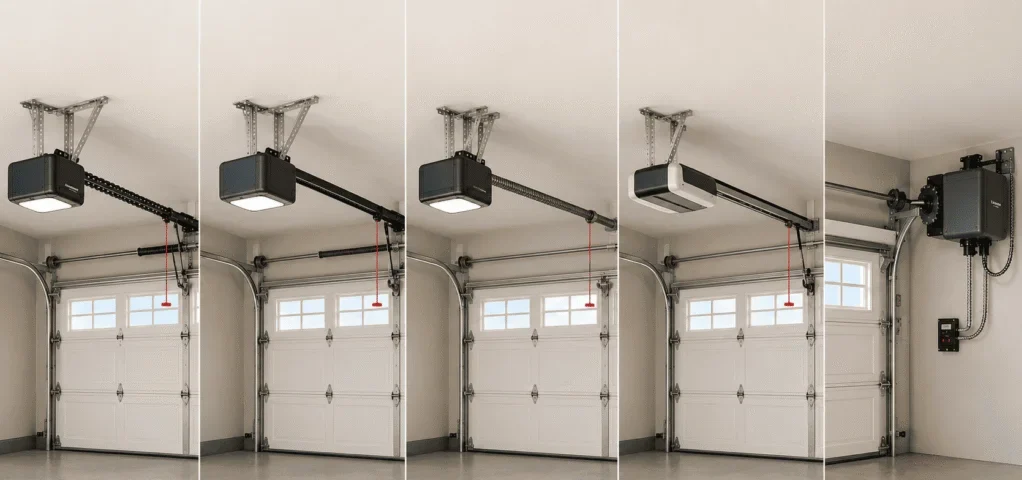
One of the most important decisions is the drive system. The drive transfers the motor’s movement to the garage door.
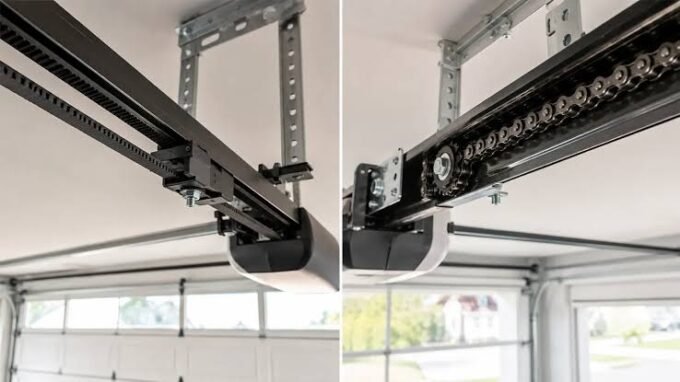
The three common choices are belt drive, chain drive, and screw drive.
Each has a different combination of noise, maintenance needs, durability, and price.
Belt-Drive Garage Door Openers
Belt-drive systems use a reinforced belt rather than a traditional metal chain.
Their biggest advantage is usually quiet operation. This makes them particularly attractive for garages located beneath bedrooms, living rooms, or other frequently used areas.
A good belt-drive system can also provide smooth operation and less vibration.
However, belt-drive models can cost more than basic chain-drive openers.
Chain-Drive Garage Door Openers
Chain-drive systems use a metal chain to move the door.
They have been used for decades and remain popular because they can provide reliable performance at a relatively accessible price.
The trade-off is noise. A chain-drive opener may produce more vibration and mechanical sound than a belt-drive model.
If your garage is separated from your main living space, this may not be a major concern.
Screw-Drive Systems
Screw-drive openers use a threaded steel rod to move the trolley.
They have fewer moving components than some traditional systems and can offer strong performance. However, their suitability can depend on the garage environment and manufacturer’s design.
Temperature and maintenance requirements should be checked before choosing this type.
Belt vs. Chain: Which One Makes More Sense?
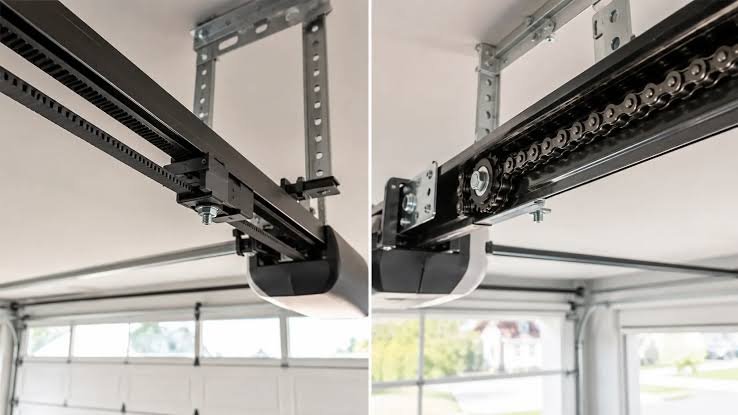
If you are comparing a belt vs chain garage door opener, consider where the garage is located and how often the door operates.
A belt system is often attractive when quiet operation is a priority. A chain system may make more sense when cost and proven mechanical design are higher priorities.
There is no universal answer. The best choice depends on your home, budget, and expectations.
Smart Features Are Changing Garage Door Security
Modern garage door openers increasingly connect to Wi-Fi and smartphone apps.
This means your garage door can become part of your wider smart-home system.
Depending on the model, smart features may allow you to:
- Open or close the door remotely
- Check whether the door is open
- Receive activity notifications
- Give temporary access to family members
- Integrate with selected smart-home platforms
- Monitor activity through an app
Imagine leaving home and suddenly wondering whether you closed the garage door.
Instead of turning around, you may be able to check its status from your phone and close it remotely if the system supports that feature.
That convenience is particularly useful for busy households.
Smart Does Not Always Mean More Secure
A connected opener can provide useful security features, but internet connectivity also makes software and account security important.
Choose a manufacturer that provides regular app support and uses appropriate account security measures.
Use a strong, unique password for your account and enable additional authentication when available.
Convenience should support security, not replace it.
Safety Features You Should Not Ignore
Garage doors are heavy mechanical systems, so safety technology deserves serious attention.
Modern openers commonly use sensors that detect objects or people beneath the closing door. If the system detects an obstruction, the door should respond according to the manufacturer’s safety design.
Look for features such as:
- Automatic reversing
- Photoelectric safety sensors
- Rolling-code remote technology
- Manual release
- Motion-sensitive lighting
- Vacation or lock functions
- Battery backup
Safety sensors should also be correctly installed and kept clean.
Even the most advanced opener cannot provide proper protection if its sensors are blocked, damaged, or incorrectly aligned.
Battery Backup Can Be More Valuable Than You Think
Power outages are inconvenient, especially when the garage is your primary entrance.
A battery backup system can allow compatible garage door openers to continue operating when household power is unavailable.
This can be especially useful during storms, winter weather, or unexpected electrical failures.
Consider a simple scenario.
You return home during a power outage. The garage door does not respond to the wall control or remote. Without another entrance, accessing the garage can become difficult.
Battery backup can reduce this problem by providing temporary operation.
Before buying, check how many opening cycles the backup battery is designed to support and whether the battery requires periodic replacement.
What Is the Quietest Garage Door Opener?
If noise is your main concern, look closely at the drive mechanism, installation quality, and door condition.
The quietest garage door opener is not necessarily determined by the motor alone.
A belt-drive system is often a strong choice for homeowners who want reduced noise. However, worn rollers, loose hardware, poor lubrication, or an unbalanced door can still create considerable sound.
For example, replacing an old noisy opener may help, but replacing worn rollers at the same time can make an even bigger difference.
Think of the entire garage door system rather than one component.
Wall-Mounted vs. Ceiling-Mounted Openers
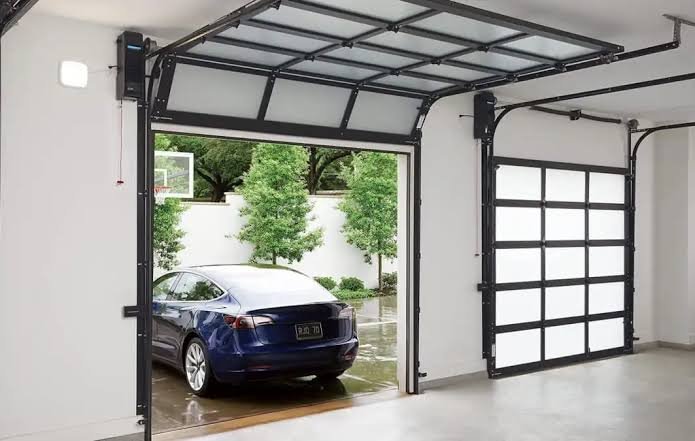
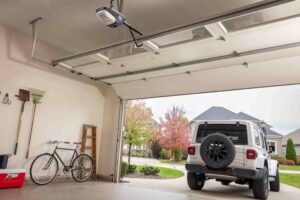
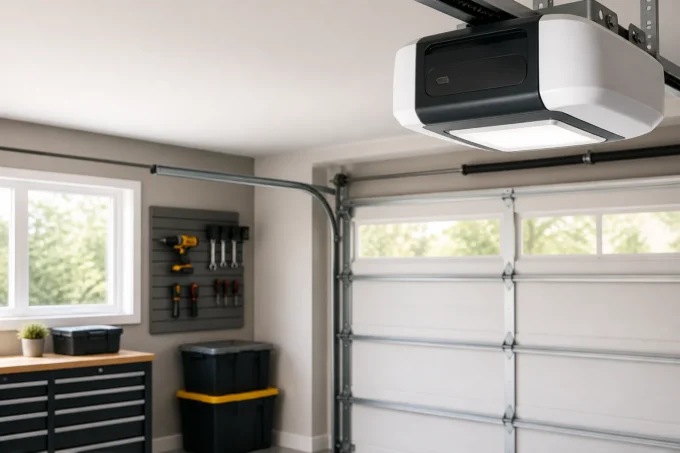
Traditional garage door openers are usually installed on the ceiling above the door.
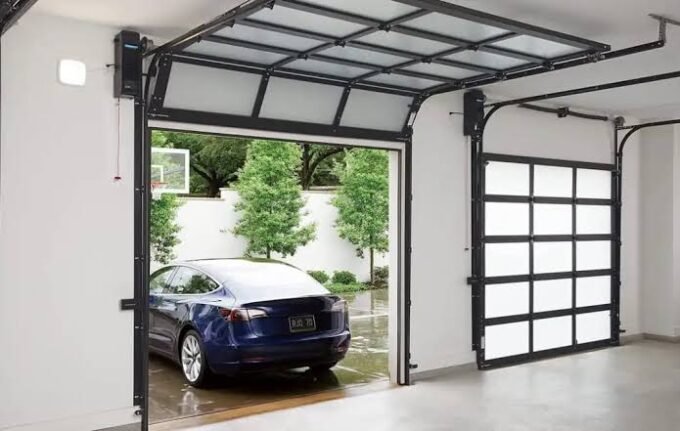
However, wall-mounted models have become increasingly popular because they attach beside the garage door rather than hanging from the ceiling.
When considering wall mount garage door opener vs ceiling mount, look at your garage layout first.
Wall-Mounted Advantages
Wall-mounted systems can:
- Free up ceiling space
- Work well with certain high or unusual ceilings
- Reduce overhead clutter
- Provide a cleaner appearance
- Potentially make ceiling storage easier
They can be especially useful in garages where overhead storage is important.
Ceiling-Mounted Advantages
Ceiling-mounted systems are widely available and come in many designs and price ranges.
They are also familiar to many installers and homeowners.
However, they require adequate overhead clearance and can occupy space that might otherwise be used for storage.
Neither design is automatically better. The physical layout of your garage should guide the decision.
When Do You Need a Heavy-Duty Opener?
Large, heavy, or frequently used doors may require a heavy duty garage door opener designed for demanding operation.
However, bigger is not always better.
Before upgrading to a stronger opener, check the door’s:
- Weight
- Width
- Height
- Construction
- Balance
- Frequency of use
Commercial-style or oversized residential doors may have different requirements from ordinary residential garage doors.
If you are unsure, have the garage door professionally inspected before choosing an opener.
Best Garage Door Openers for Different Homes
The right opener depends heavily on your priorities.
For Attached Garages
A belt-drive model can be attractive because it may reduce noise and vibration.
This is particularly useful when bedrooms or living areas are directly above or beside the garage.
For Budget-Conscious Homeowners
A chain-drive system may provide a practical balance between cost and functionality.
Look for essential safety features rather than paying extra for smart functions you will never use.
For Smart Homes
A Wi-Fi-enabled opener can be useful if you already use smart-home technology.
Check compatibility with your existing ecosystem before purchasing.
For Homes With Frequent Power Outages
Prioritize battery backup.
The feature may cost more initially, but it can provide valuable convenience when electricity is unavailable.
For Garages With Limited Ceiling Space
A wall-mounted opener may be worth considering.
Measure the available side clearance and confirm that the opener is compatible with your garage door system.
Top Features to Compare Before Buying
When comparing the top rated garage door openers, do not focus only on ratings or star counts.
Instead, create a simple comparison based on your actual needs.
| Feature | Why It Matters |
| Belt drive | Lower operating noise |
| Chain drive | Proven design and often lower cost |
| Wi-Fi | Remote access and notifications |
| Battery backup | Operation during power outages |
| LED lighting | Better garage visibility |
| Rolling-code security | Helps prevent unauthorized remote access |
| Wall mounting | Saves overhead space |
| Strong motor | Useful for compatible heavier doors |
| App support | Convenient remote monitoring |
| Warranty | Adds long-term value |
This approach helps prevent you from paying for features that do not benefit your household.
Installation: DIY or Professional?
Some homeowners are comfortable installing garage door openers themselves.
However, installation involves electrical connections, mechanical components, safety sensors, and correct adjustment.
If you already have experience with similar equipment and the manufacturer provides clear instructions, DIY installation may be possible for certain models.
For complex installations, professional installation can reduce the risk of incorrect setup.
Never bypass safety sensors or other protective mechanisms to make installation easier.
A properly installed opener should operate smoothly without excessive force, vibration, or unusual noise.
How to Make Your Garage Door Opener Last Longer
Even a quality opener needs basic care.
You can help extend its service life by:
- Keeping safety sensors clean
- Checking unusual noises early
- Inspecting cables and hardware visually
- Keeping the door properly balanced
- Following the manufacturer’s lubrication instructions
- Replacing remote batteries when needed
- Updating smart-home apps and firmware when appropriate
- Testing safety reversal features according to manufacturer guidance
Most importantly, do not ignore changes in performance.
A door that suddenly becomes slow, jerky, unusually loud, or difficult to operate may have a mechanical problem.
The opener should not be expected to compensate for a failing door system.
Personal Insight: Think About Your Daily Routine
One of the simplest ways to choose an opener is to imagine using it every day for the next five years.
Do you come home late at night?
You may appreciate bright automatic lighting.
Do you have bedrooms above the garage?
Noise reduction may be more important.
Do you travel frequently?
Remote monitoring could be useful.
Do you experience regular power interruptions?
Battery backup may deserve a higher place on your list.
This simple exercise can be more useful than choosing an opener solely because it has the highest number of features.
A Simple Buying Checklist
Before purchasing, ask yourself these questions:
- How heavy is my garage door?
Check the manufacturer’s specifications or have the door professionally assessed. - Is noise important?
If the garage is attached to living areas, consider a quieter drive system. - Do I want smartphone control?
If yes, verify Wi-Fi compatibility and app support. - Does my area experience power outages?
If so, consider battery backup. - How much ceiling space do I have?
A wall-mounted design may be useful in some layouts. - How often does the door operate?
Frequent daily use can make durability and motor design more important. - Who will install it?
Decide whether professional installation is appropriate before buying.
How Much Should You Pay?
Garage door opener prices vary significantly depending on the drive system, motor design, smart features, installation, and accessories.
A basic opener may be relatively affordable, while a premium smart system with battery backup and advanced lighting can cost considerably more.
Instead of choosing the cheapest option, consider total value over time.
A slightly more expensive opener may offer quieter operation, better connectivity, stronger support, or a longer warranty.
For example, spending more may make sense when the garage is attached to a bedroom. On the other hand, a basic chain-drive system could be perfectly practical for a detached garage.
Why Garage Door Technology Is Becoming Smarter
The garage is increasingly becoming part of the connected home.
Smart lighting, security cameras, video doorbells, smart locks, and connected garage door openers can work together to create a more convenient entry system.
However, technology should solve a real problem.
A smartphone app is useful if you frequently need remote access. It is less valuable if you never use remote features.
Similarly, advanced lighting can be helpful in a dark garage, while unnecessary connectivity may simply add complexity.
The smartest purchase is not necessarily the one with the most technology. It is the one that fits your lifestyle.
Conclusion
Choosing among the Best Garage Door Openers requires more than comparing motor power or online ratings.
Start with the garage door itself. Consider its size, weight, balance, and frequency of use. Then think about the features that will actually improve your daily routine.
For quieter homes, a belt-drive system may be appealing. For homeowners who want simple and proven operation, a chain-drive design may be suitable. Smart connectivity can add convenience, while battery backup can be particularly valuable during power outages.
Moreover, safety should remain a priority regardless of price or technology.
The best garage door opener for your home is the one that combines reliable operation, appropriate power, useful safety features, and the level of convenience you genuinely need.
Before buying, compare the drive system, installation requirements, warranty, smart features, and compatibility with your existing garage door.
A thoughtful choice today can mean years of smoother, quieter, and more convenient garage access.
Frequently Asked Questions
What should I look for in a garage door opener?
Look at the drive type, motor capacity, safety features, noise level, smart connectivity, battery backup, warranty, and compatibility with your garage door.
Are belt-drive garage door openers quieter?
Generally, belt-drive systems are designed to produce less mechanical noise and vibration than traditional chain-drive systems. They can be particularly suitable for attached garages.
Is a smart garage door opener worth it?
It can be useful if you want smartphone control, remote monitoring, activity alerts, or smart-home integration. However, these features are not essential for every household.
Do I need battery backup?
Battery backup can be valuable if your garage is an important entrance or your home experiences power outages. Check how many operating cycles the backup system supports.
Should I install a garage door opener myself?
Some homeowners can install compatible systems themselves, but professional installation may be preferable for complex setups. Always follow the manufacturer’s instructions and keep all safety systems active.







1 Comment