



Have you ever noticed water spilling over the sides of your gutters during heavy rain? Or perhaps you have seen leaves, twigs, and dirt collecting around your roofline. These small signs may seem harmless, but they can point to a problem that deserves attention.
Gutter cleaning is an important part of home maintenance because gutters direct rainwater away from your roof, walls, and foundation. When they become blocked, water can overflow and damage several parts of your property.
Fortunately, keeping your gutters clear does not have to be complicated. With the right tools, a sensible schedule, and a few safety precautions, homeowners can reduce the risk of expensive repairs.
In this guide, you will learn how to inspect your gutters, remove debris, choose the right equipment, estimate expenses, and recognize situations that require professional help.
Why Gutter Cleaning Is Essential for Home Protection
Your gutter system has a simple but important job: collect rainwater from the roof and carry it safely away from your house.
However, leaves, pine needles, roof grit, and other debris can block the channels. Once water cannot flow freely, it may spill over the edges or collect in places where moisture can cause damage.
Regular maintenance helps prevent these problems before they become expensive.
1. Prevents roof and fascia damage
When gutters remain clogged, trapped water can sit against the roof edge and fascia boards. Over time, repeated exposure to moisture may contribute to wood rot, damaged paint, and deterioration around the roofline.
In colder climates, standing water can also freeze. Ice buildup may add weight to the gutter system and increase the risk of damage.
2. Protects your home’s foundation
Rainwater should flow through downspouts and drain away from the foundation. If a blockage causes water to pour directly beside the house, the surrounding soil may become saturated.
Depending on the property and soil conditions, this can contribute to basement moisture, foundation problems, or erosion around the building.
3. Reduces pest problems
Wet leaves and organic debris create shelter for insects and other small pests. Blocked gutters may also hold standing water, creating conditions that some insects can use for breeding.
Keeping the system clean removes much of this unwanted material and helps reduce moisture-related pest issues.
4. Extends the life of your gutter system
Debris and standing water can place extra weight on gutters and their brackets. Over time, this pressure may cause sections to sag, pull away from the fascia, or develop drainage problems.
Routine inspections help identify loose fasteners, small leaks, and early signs of wear.
How Often Should You Clean Your Gutters?

There is no single schedule that works for every property. The best frequency depends on nearby trees, local weather, roof design, and the type of gutter protection installed.
For many homes, cleaning at least twice a year is a useful starting point.
| Property condition | Suggested maintenance |
| Few nearby trees | Inspect and clean in spring and fall |
| Many deciduous trees | Inspect more frequently during leaf fall |
| Pine trees nearby | Check regularly for needles and small debris |
| Heavy storms or strong winds | Inspect after significant weather events |
| Older or damaged gutters | Arrange more frequent inspections |
| Gutter guards installed | Inspect periodically and clean as needed |
These are general guidelines rather than strict rules. A home surrounded by mature trees may need attention much more often than a property with an open yard.
Best times for gutter maintenance
Spring: Remove winter debris, check for loose brackets, and prepare the system for spring showers.
Fall: Clear fallen leaves before prolonged rain and freezing weather arrive.
After major storms: Look for branches, roof debris, damaged downspouts, and sections that have pulled away from the house.
Moreover, inspect the system whenever you notice water overflowing, damp exterior walls, or unexpected puddles near the foundation.
Essential Gutter Cleaning Tools for Better Results
Choosing suitable equipment makes the job easier and helps reduce unnecessary risks. Before starting, consider the height of your house, the condition of your gutters, and the amount of debris you need to remove.
Useful gutter cleaning tools include:
- Work gloves: Protect your hands from sharp metal edges, rough debris, and insects.
- Safety glasses: Help prevent dirt and small particles from entering your eyes.
- Gutter scoop: Removes compacted leaves, mud, and other material.
- Garden hose: Flushes loose debris and helps you check water flow.
- Bucket or debris bag: Keeps removed material from falling onto walkways and garden beds.
- Extension pole: Allows you to reach some gutter sections from the ground.
- Stable ladder: Provides access when ground-based methods are unsuitable and conditions permit safe ladder use.
- Work shoes with good grip: Reduce the chance of slipping while moving around the work area.
You do not need to purchase every item. For a single-story home with limited debris, a scoop, gloves, and hose may be sufficient.
However, tools alone cannot make a dangerous working position safe. Never lean far beyond a ladder’s side rails or attempt to reach gutters while standing on a roof with poor footing.
How to Clean Gutters: A Step-by-Step Guide
Understanding how to clean gutters safely starts with preparation, a careful inspection, and a methodical approach.
Step 1: Check the weather and surrounding area
Choose a dry, calm day. Wet surfaces, strong winds, and thunderstorms make exterior maintenance more hazardous.
Move outdoor furniture and other obstacles away from the work area. Keep children and pets at a safe distance, and check for overhead electrical lines before using long poles or ladders.
Step 2: Inspect the gutter system
Walk around your home and look for obvious problems before removing debris.
Check for:
- Sagging or detached gutter sections
- Visible cracks, rust, or holes
- Downspouts that appear blocked
- Plants growing inside the gutters
- Water stains below the roofline
- Loose brackets and damaged joints
If the gutters are badly damaged or difficult to access, arrange a professional inspection before attempting to clean them.
Step 3: Remove large debris

Start with visible leaves, twigs, and accumulated organic material. Use a scoop or gloved hands to remove debris carefully.
Work in manageable sections rather than trying to clear the entire roofline at once. Place waste in a bucket or bag instead of dropping it onto the ground.
Never reach into a gutter without checking for sharp metal edges, insects, or other hazards.
Step 4: Check and clear the downspouts
Clean gutters cannot drain properly if their downspouts are blocked.
After removing the loose debris, check the downspout opening. A hose may help flush away minor blockages, provided the system is accessible and there is no risk of flooding or damaging the pipe.
If water backs up or refuses to flow, the blockage may be deeper inside the system. Avoid forcing equipment into the pipe, as this could damage joints or fittings.
Step 5: Flush the gutters
Use a garden hose to move remaining dirt toward the downspout. Observe the water as it travels through the gutter.
Water should flow without persistent pooling or spilling over the edges. If it collects in one area, the gutter may have an incorrect slope, a hidden blockage, or a damaged section.
Step 6: Inspect the results
Once the debris is removed, check the gutters and downspouts again.
Look for leaks around joints, loose brackets, and signs that water is draining toward the house instead of away from it.
Remember that cleaning and repairing a gutter system are different tasks. If you identify structural damage, arrange appropriate repairs rather than relying on cleaning alone.
Gutter Cleaning Tools Without a Ladder: Are They Effective?
Ground-based equipment can be a useful option for homeowners who want to avoid climbing. However, its effectiveness depends on the height of the building, the gutter design, and the type of debris.
Popular options include:
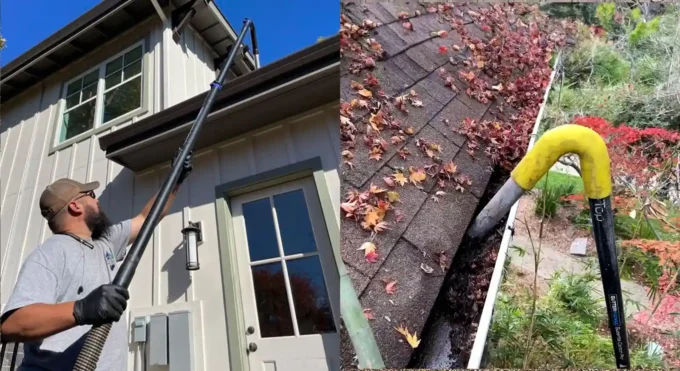
Telescopic gutter wands: These connect to a hose and direct water into accessible gutters from the ground.
Curved gutter attachments: Specially shaped hose attachments help direct water into the gutter channel.
Wet-and-dry vacuum attachments: Some vacuum systems include extensions designed to remove dry leaves and loose debris.
Specialized gutter cleaning poles: These tools may include scoops or brushes that help remove material without direct ladder access.
Gutter cleaning tools that work without a ladder offer a useful option, but no single tool works for every home.
For example, a long pole may remove dry leaves from a single-story gutter but struggle with compacted mud or wet pine needles. A hose attachment may clear loose material without removing a dense blockage.
Moreover, water pressure can push debris into a downspout or splash dirt onto windows and walls. Follow the equipment manufacturer’s instructions and inspect the drainage afterward.
If your home has high rooflines, difficult access, or heavy blockages, a professional service is often the safer choice.
Common Gutter Cleaning Mistakes to Avoid
Even a simple maintenance task can cause problems when performed carelessly. Avoid these common mistakes to protect both your home and yourself.
Using an unstable ladder
Never place a ladder on soft, uneven, or slippery ground. Use equipment suitable for the height and conditions, follow its safety instructions, and maintain proper ladder positioning.
Do not climb onto the top steps or overreach to reach another section. If you cannot work comfortably within a safe position, stop.
Ignoring the downspouts
Removing leaves from the gutter channel does not guarantee proper drainage. A blocked downspout can cause water to back up during the next storm.
Always check the complete drainage path, including the outlet.
Cleaning only when problems appear
Overflowing water is an obvious warning sign, but it often appears after debris has already accumulated.
Regular inspections help you identify developing problems before they affect walls, landscaping, or the foundation.
Using excessive water pressure
High-pressure equipment may damage older gutters, force water behind siding, or loosen weak connections.
Use appropriate equipment and moderate pressure. Follow the manufacturer’s guidance for the gutter material and cleaning method.
Forgetting to inspect the roofline
The condition of the gutter brackets, fascia boards, and nearby roof edges matters just as much as the debris inside the channel.
However, do not climb onto a roof to inspect these areas if you lack the necessary training and safety equipment. A ground-level visual inspection or professional assessment may be more appropriate.
What Affects Gutter Cleaning Cost?
The total cost of gutter cleaning depends on several factors, including the height of the property, the length of the gutters, the amount of debris, and whether the contractor must clear difficult downspouts.
Other factors may include regional labor rates, access restrictions, travel charges, and the condition of the existing gutter system.
Main factors that influence the price
- House size: Larger homes often have more gutter sections to clean.
- Building height: Multi-story properties usually require additional equipment and labor.
- Debris level: Heavy buildup may take longer to remove.
- Accessibility: Steep rooflines, landscaping, and limited access can increase the complexity of the work.
- Additional services: Minor repairs, downspout flushing, or gutter guard work may cost extra.
Gutter cleaning prices vary significantly by location and service provider. Therefore, it is better to request itemized quotes than to rely on a single online estimate.
When comparing offers, ask whether the price includes downspouts, debris removal, a final inspection, and cleanup around the property.
Also, confirm whether repairs are charged separately. A low initial quote may not include all the work your home requires.
Should You Hire a Professional Gutter Cleaner?
DIY maintenance may suit homeowners with accessible, single-story properties and manageable debris. Professional service is worth considering when the work involves substantial height, complex rooflines, or signs of damage.
Benefits of hiring a professional
An experienced contractor may be able to:
- Remove debris from difficult-to-reach sections
- Identify leaks and loose gutter brackets
- Check downspouts and drainage performance
- Recommend appropriate repairs
- Complete the work using suitable safety equipment
However, not every contractor offers the same services. Ask about insurance, experience, safety procedures, and the scope of the quote before booking.
If the company offers both roof and gutter cleaning, clarify exactly what is included. Cleaning gutters does not automatically mean the contractor will inspect or clean the entire roof.
When professional help is especially important
Consider hiring a qualified service if:
- Your home has multiple stories.
- The ground around the house is uneven.
- Gutters are severely blocked or damaged.
- You see signs of rot or water intrusion.
- Electrical lines or other hazards are close to the work area.
- You are uncomfortable using a ladder.
The safest maintenance plan is one that accounts for your home’s design and your own experience.
Gutter Cleaning and Repair: When Maintenance Is Not Enough
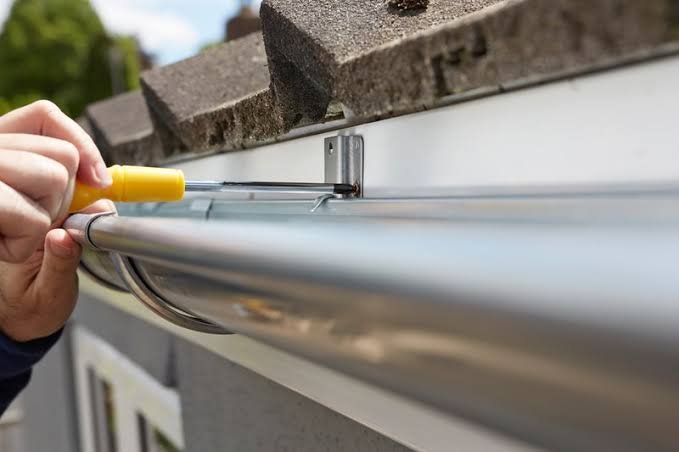
Cleaning removes debris, but it cannot fix every drainage problem. Sometimes, the gutter system needs repair or replacement to work correctly.
Common warning signs include persistent leaks, separated joints, rust holes, sagging sections, and water that continues to pool after the channel has been cleared.
Common gutter repairs
Leaking joints: Sealants or replacement fittings may be needed, depending on the cause and condition of the joint.
Loose brackets: Securely reattaching or replacing damaged supports can restore stability.
Incorrect slope: Adjustments may be necessary if water consistently collects instead of flowing toward the outlet.
Damaged downspouts: Cracked or disconnected sections may need repair or replacement.
Rotten fascia boards: The underlying wood may require repair before new gutter fasteners can hold securely.
Do not simply cover a major leak with sealant without investigating the cause. A damaged joint, poor alignment, or deteriorated support may require a more complete solution.
Moreover, repeated overflow after cleaning can indicate that the system is undersized, incorrectly installed, or unable to handle the water volume during heavy rain.
Are Gutter Guards Worth Installing?
Gutter guards are designed to reduce the amount of leaves and other debris entering a gutter system. They can reduce maintenance needs, particularly on homes surrounded by trees.
However, they do not eliminate the need for inspections.
Different designs perform differently depending on the type of debris, roof shape, and rainfall conditions. Small openings can become clogged with fine particles, while some guards allow needles or seeds to enter.
Comparing common gutter guard types
| Type | Main advantage | Potential limitation |
| Mesh screens | Block many leaves and larger debris | Fine particles may accumulate |
| Micro-mesh guards | Filter smaller debris | May require surface cleaning |
| Foam inserts | Fit inside many gutter channels | Can collect dirt and may need replacement |
| Brush inserts | Catch larger leaves and twigs | Debris can become trapped between bristles |
The best choice depends on the property rather than the product’s marketing claims.
Gutter cleaning and guard installation can be combined into a single maintenance project, but installation should follow an inspection of the existing gutters. Adding guards to damaged, poorly sloped, or undersized gutters will not correct those underlying problems.
Ask installers about material durability, compatibility, maintenance requirements, and warranty coverage before making a decision.
Seasonal Gutter Maintenance Checklist
A simple checklist makes it easier to keep your gutter system in good condition throughout the year.
Spring
- Remove leaves and debris left from winter.
- Check for loose brackets and visible cracks.
- Flush downspouts where appropriate.
- Look for signs of water damage near the roofline.
Summer
- Inspect after severe storms.
- Remove small branches and accumulated debris.
- Check visible joints for leaks.
- Make repairs before the next period of heavy rain.
Fall
- Monitor leaf buildup as trees lose their leaves.
- Clean gutters after significant leaf fall.
- Check downspouts before colder weather arrives.
- Inspect gutter guards for accumulated material.
Winter
- Watch for unusual ice buildup and drainage problems from the ground.
- Avoid climbing ladders in icy or snowy conditions.
- Arrange professional help if damage or dangerous ice accumulation develops.
This checklist can be adjusted to suit local weather and the trees around your property.
For example, a house beneath evergreen trees may need more frequent checks than a home in an open area. Similarly, a property exposed to strong winds may collect debris even when few trees grow nearby.
Conclusion: Make Gutter Maintenance a Regular Habit
Clean, well-maintained gutters help direct rainwater away from your roof, exterior walls, and foundation. Although the task may seem minor, neglecting it can lead to drainage problems, wood damage, pest concerns, and avoidable repair expenses.
The most effective approach is to inspect your gutters regularly, remove debris safely, check the downspouts, and address damage as soon as you notice it.
You can handle some simple maintenance tasks yourself when access is safe. However, high gutters, difficult rooflines, and serious damage are good reasons to contact a qualified professional.
The key takeaway: Do not wait for water to overflow before checking your gutters. A little preventive maintenance can help protect your home and make future repairs easier to manage.
Frequently Asked Questions
1. How often should gutters be cleaned?
Most homes benefit from cleaning at least twice a year, usually in spring and fall. Properties surrounded by trees or exposed to frequent storms may need more frequent inspections and cleaning.
2. Can I clean my gutters without a ladder?
Yes, some extension poles, hose attachments, and specialized vacuum systems can remove accessible debris from the ground. However, these tools may not clear compacted material or reach every section effectively.
3. What happens if gutters are never cleaned?
Blocked gutters can overflow, contribute to fascia damage, affect exterior walls, and direct water toward the foundation. The exact consequences depend on the property’s drainage system, soil, and weather conditions.
4. Is professional gutter cleaning worth the money?
Professional service can be worthwhile for multi-story homes, difficult access, heavy blockages, or damaged gutters. Compare itemized quotes and confirm that the provider follows appropriate safety procedures.
5. Do gutter guards eliminate the need for cleaning?
No. Gutter guards can reduce debris buildup, but leaves, needles, dirt, and small particles may still collect on or beneath them. Periodic inspection and maintenance remain important.











1 Comment